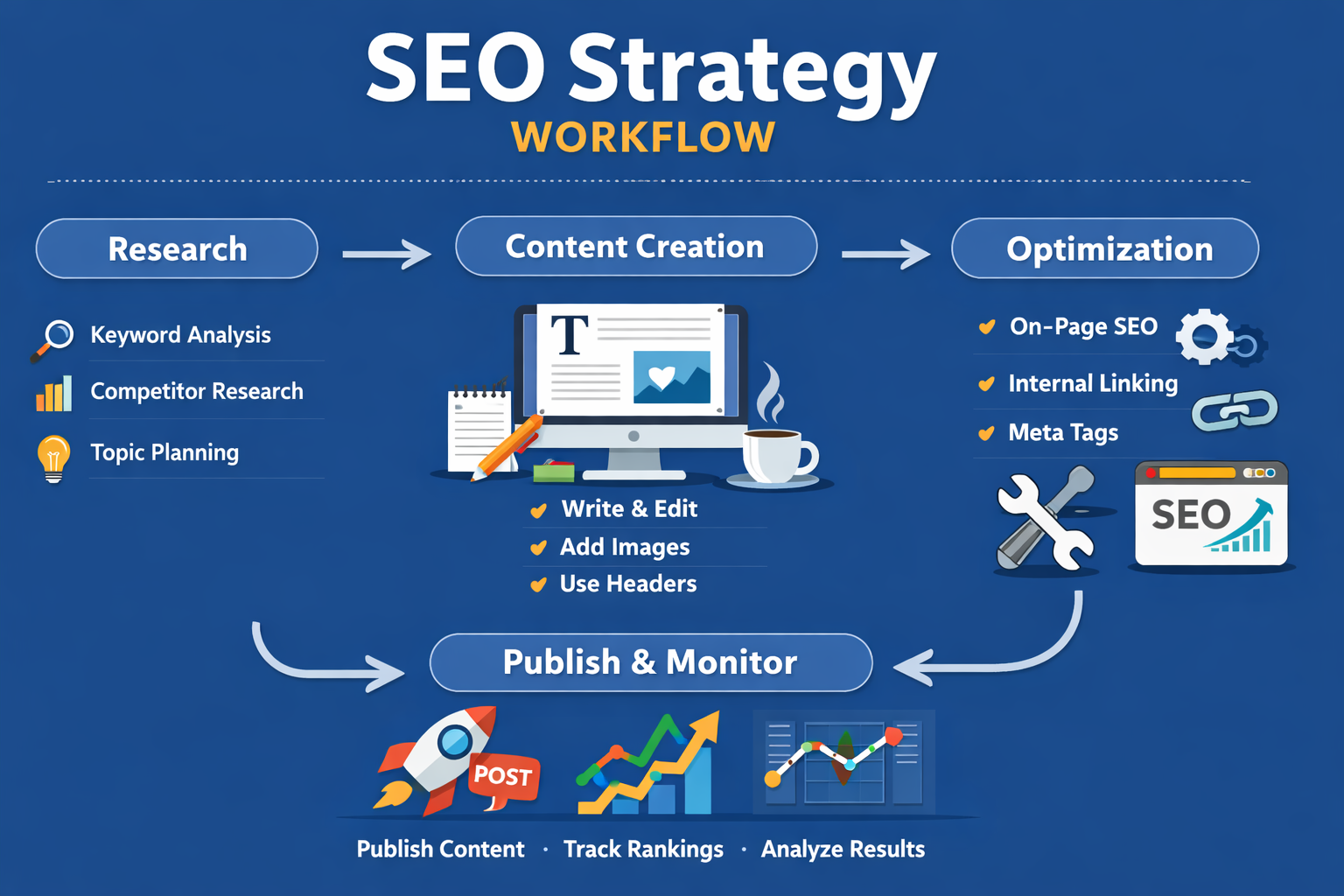
Companies Unlock Better Places through Strategic SEO Content Writing.
In the modern competitive digital environment, one should not merely post some content online. Companies, advertisers, and content developers are now forced to concentrate on creating SEO pieces that are not only appealing to the readers but also top-ranking in the search engine. This balance has become the key to success and the primary goal of a brand that strives to gain more visibility, organic traffic, and conversions.
Search engine optimization content writing involves both creativity and technical knowledge, as well as strategy. With further development of the search engine algorithms, content has to provide real value, correspond to the intent of the user, and be based on the best practices to keep up with the competition.
What is SEO content?
SEO content is the kind of content that is created to be ranked in the search engines, such as Google. It caters to pertinent keywords, provides user search solutions, and is designed to increase search and readability.
SEO content is an important part of an overall content development plan (CDP). It is important to note that key components of a website include a content plan, a product plan, and an information technology plan. <The following are important characteristics of SEO content.
SEO content is purposefully written. It has been written with keywords naturally, organized headings, and useful and easy-to-comprehend information. Meanwhile, it aims at providing a positive user experience as opposed to satisfying algorithms.
The Ultimate Guide to Writing SEO Content That Ranks.
1. Carry out proper keyword research.

SEO content is based on keyword research. It aids in determining the type of information that users are seeking and the way they are wording their search questions. With the help of appropriate keywords, particularly long-tail ones, the creators of the content will be able to better align with the needs of the audience.
The knowledge of the competition of keywords and volume of searches can also assist in selecting keywords that can provide realistic ranking possibilities.
2. Focus on Search Intent
Search intent can be defined as why a user has their query. When one wants to find, attempt to buy something, or locate a particular web page, the content should be appropriate to that purpose.
This is because when the contents are rendered for the purpose of the user, they will be more relevant and are likely to be ranked higher and more advantageous.
3. Produce Quality, Valuable Content.
The most important ranking factor is high-quality content. Men in charge of search engines focus on informative and original content that will be of use to the readers.
Rather than using all keywords in the articles, one should be clear in answering questions, making insights, and giving practical value. Authentic content that is beneficial to the users will work better in the long run.
4. Provide the right content structure.
Content is easier to read and comprehend because of a well-organized structure. The title with H1 and sections with H2 and H3 make it logically flow, and this enhances the performance of the SEO.
Clearly spaced paragraphs, clear headings, and short paragraphs enable readers to navigate the information fast, and this aspect also increases user experience and decreases bounces.
5. Optimize On-Page Elements
On-page SEO factors are very important in the performance of content in the search results. There should be relevant keywords that need to be included in the title tags, meta descriptions, and even the URLs, but they should be written naturally and appealingly.
The other consideration is internal linking, which promotes site structure to the search engines and motivates users to read more content.
6. Write Engaging Headlines
The users tend to notice the first thing, which is the headline. An interesting title can drastically increase the number of people clicking on the news as well as the number of people visiting the page.
Good headlines are precise, brief, and mostly contain actionable language that is not misleading.
7. Improve Readability
Easy-to-read content makes users spend more time. Simple language, fewer sentences, and a conversational tone can play a huge role.
Space between and a clean design will also help in enhancing the reading experience, more so among mobile users.
8. Maximize Featured Snippets.
The featured snippets are placed on the first page of search results and are an indication of immediate replies to the queries used by the user. Organizing the content so as to directly respond to queries enhances the chances of being published.
Explicit explanations, summaries, and clear sections are used to enhance visibility in these posts.
9. Update Content Regularly
SEO is not a one-time effort. The relevancy and accuracy of content over time are achieved by updating. It can also be possible to refresh old information, add something new, and optimize to stay on top or increase ranking.
The advantages of SEO content that ranks.
Production of SEO-oriented material gives the business benefits in the long term. It contributes to boosting organic traffic, boosts brand presence, and makes the audience more engaged. In the long term, the increase in the rates of conversions and the online authority can also be achieved as a result of the regular SEO activities.
Conclusion
To come up with SEO writing that would actually rank, the balance between user-friendly writing and technical optimization must be given careful consideration. Through search intent, proper research, and high-quality standards, the businesses can produce content that not only ranks well at the search engines but also provides real value to the audience.
With the ever-increasing levels of digital competition, a consistent effort and adoption of SEO best practices will be a critical entry point to long-term success.
FAQs
1. How many characters should search engine content have?
The optimal length will change based on the topic and the competition, but 800 to 1500 words of content tend to perform well. One should always look at quality and completeness and not word count.
2. What is the number of keywords to be used in a single article?
The best approach is to do the research on a single keyword and several related ones. It is aimed at preserving natural readability without excessive use of keywords.
3. SEO content: How long can it take to rank?
The outcome of SEO takes time. It may be a few weeks or even a few months based on the factors that include competition, the difficulty of a keyword, and the quality of content.
4. Can I rank without backlinks?
Although this can be done in low-competition niches, backlinks are a big factor in enhancing rankings. Quality content, nevertheless, is the background.
5. What should the frequency of changing my SEO content be?
It is advisable to update the content after every three to six months to ensure relevancy, accuracy, and suitability to varied search trends.