
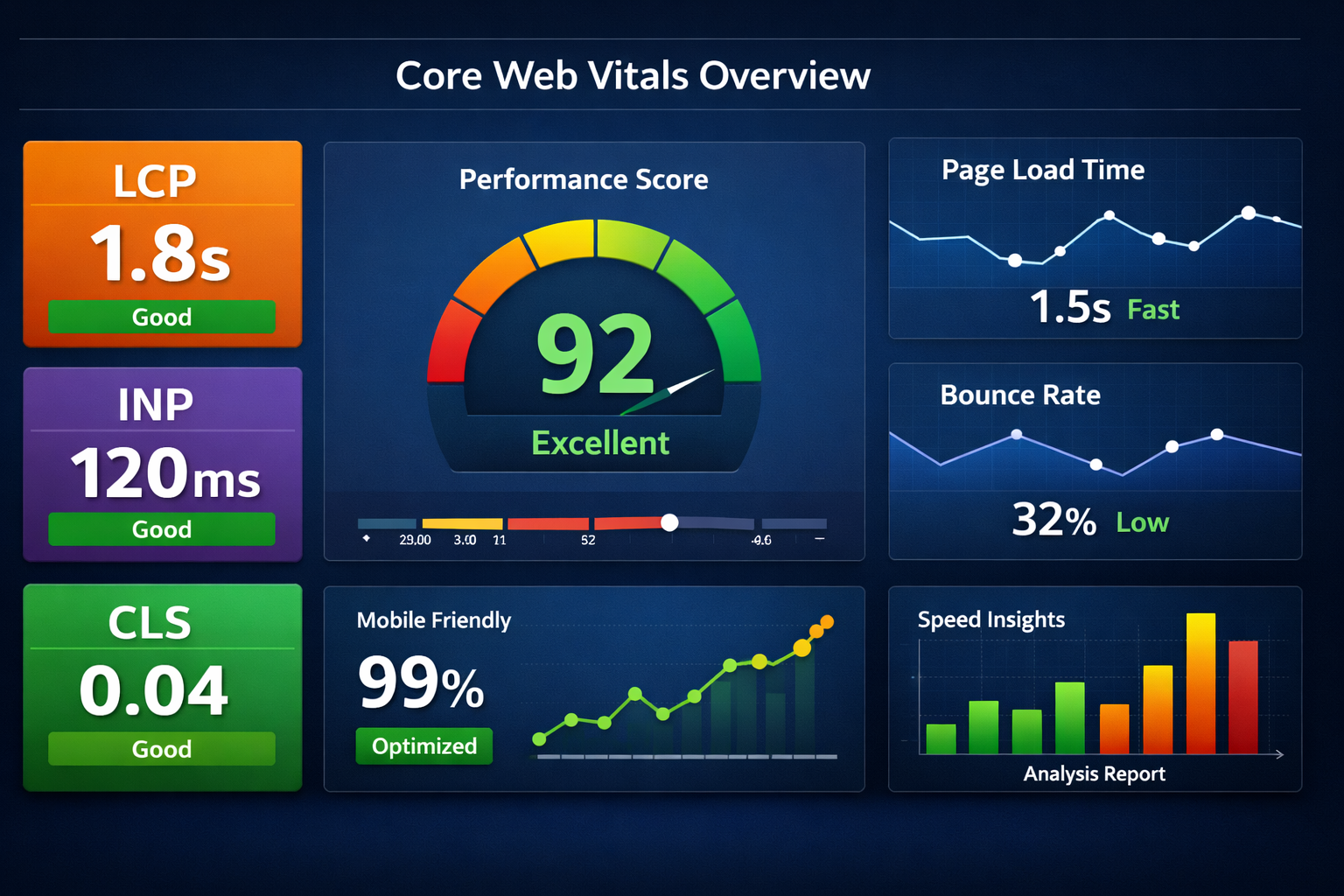
Website performance has emerged as one of the most paramount conditions in the world of digital marketing, which is changing rapidly. Companies, publishers, and websites are paying more attention to the concept of Core Web Vitals, a group of performance indicators created by Google to assess real-life user experience on websites. Since search engines are focusing on fast, stable, and responsive websites, Core Web Vitals are defining the future of SEO ranking.
According to industry observers, websites that offer superb performance and smooth user experiences will take over search results in the year 2026 and beyond. It is an indication of the new age where technical optimization, speed, and usability have a direct impact on the online success of a site.
What Are Core Web Vitals?
Core Web Vitals are a set of performance indicators that are used to calculate the experience of users on a webpage. These measures revolve around speed of loading, interactivity, and visual steadiness. Through these signals, search engines are able to identify whether a site has a positive browsing experience or not.
Largest Contentful Paint (LCP).
LCP is an indicator of the speed of the core of a webpage. The LCP score of 2.5 seconds is usually good, and visitors do not have to wait much before they get to see the main content.
Next Paint (INP) Interaction.
INP is used to gauge the reactivity of a webpage interaction by the user, e.g., clicking buttons or links. Reduced response times mean easier interactions with users and enhanced interaction.
Cumulative Layout Shift (CLS).
CLS can monitor visual stability through measuring unexpected layout change events during page loading. The low CLS score will make sure that the content does not abruptly change and the users do not get frustrated.
All of these metrics can assist the website owners to compare the effectiveness of their pages with real users.
Does Website Performance Matter in SEO?
Search engines are designed to offer the most accurate results to the users. A slow or fluctuating site may result in high bounces and lack of engagement, and this has a negative impact on search results.
As performance has become a ranking signal, websites that load fast and run smoothly will have a higher possibility of being ranked among the top search results.
The main SEO advantages of streamlined web activity are:
- Better search engine placements.
- Lower bounce rates
- Better user engagement
- Higher conversion rates
- Increased mobile usability
To companies in the online market where the competition is high, there is no such thing as an option on performance optimization; it is a necessity.
Core Web Vitals and Future SEO Strategies.
The optimization of the Core Web Vitals is now becoming part of the long-term SEO plans of the professionals working in the digital marketing field. With the development of search algorithms, the performance of websites will be even more significant.
The SEO strategies that will probably be undertaken in the future will be aimed at:
Mobile-First Optimization
Now that the majority of internet users browse on smartphones, websites should be fast to load and operate well on smartphones.
Sophisticated Performance Monitoring.
Google Search Console and PageSpeed Insights are the tools that assist the developers to keep track of Core Web Vitals and determine the problem of performance.
Effective Web Architecture.
Code optimization, decreasing server response time, and application of modern web technologies are some of the measures that will contribute to a considerable increase in performance indicators.
Those companies investing in optimization of their performance now are setting themselves up to have better SEO visibility in the future.
Most Effective Core Web Vitals.
To optimize Core Web Vitals, it is necessary to optimize it both technically and strategically. There are a number of practices, which can be used by web developers and SEO specialists to improve the performance of the websites.
Optimize Images and Media
Big pictures tend to slow down websites. Image compression and the usage of new-fangled formats, such as WebP, can help reduce the load time dramatically.
Content Delivery Network (CDN) implementation.
CDNs replicate web materials in servers worldwide, thereby decreasing the time taken by users in various locations to load.
Reduce JavaScript and CSS.
Minimal code and script optimization assist pages in loading quicker and enhance interaction velocity.
Enable Browser Caching
Caching enables the revisiting visitors to open pages faster by storing some files in their browser.
With the use of these methods, websites will be able to increase performance grades and offer improved user experiences.
Performance-driven SEO Industry Impact.
The increased significance of Core Web Vitals is affecting the whole digital ecosystem. Businesses, web developers, and marketers are changing their strategies to fit the performance requirements.
This is particularly true of the e-commerce platforms, news websites, and SaaS companies, where the speed of the websites can directly influence revenue and retention of users.
With the ever-growing competition, those organizations willing to focus on performance optimization will have a huge advantage as far as organic search visibility is concerned.
Conclusion.
Core Web Vitals has become an essential part of contemporary SEO. With search engines paying more attention to user experience, it is changing to have web performance as a technical factor into a major ranking factor.
Companies that invest in quicker loading and responsive design as well as steady page layouts will possess the chance to increase their SEO indexes, besides offering better digital experiences to their audiences. Speed, usability, and performance will be utilized as online success in the future of search.
Frequently Asked Questions (FAQs).
Q1: What are the Core Web Vitals in SEO?
Core Web Vitals are performance indicators that quantify the loading speed and responsiveness of websites and visual stability to determine the user experience on websites.
Q2: Are there any impacts of Core Web Vitals on Google rankings?
Yes. Core Web Vitals: these are an established ranking factor employed by Google to measure the experience and performance of websites.
Q3: What is a good LCP score?
The desired LCP score is below 2.5 seconds, and it means that the content of the main page loads quickly.
Q4: What are the ways of testing my site using Core Web Vitals?
Google Search Console and PageSpeed Insights are some of the tools that can be used to analyze your site.
Q5: What are the reasons why Core Web Vitals are significant in user experience?
They guarantee websites can be loaded fast, react immediately to calls, and have visual stability during the loading process.