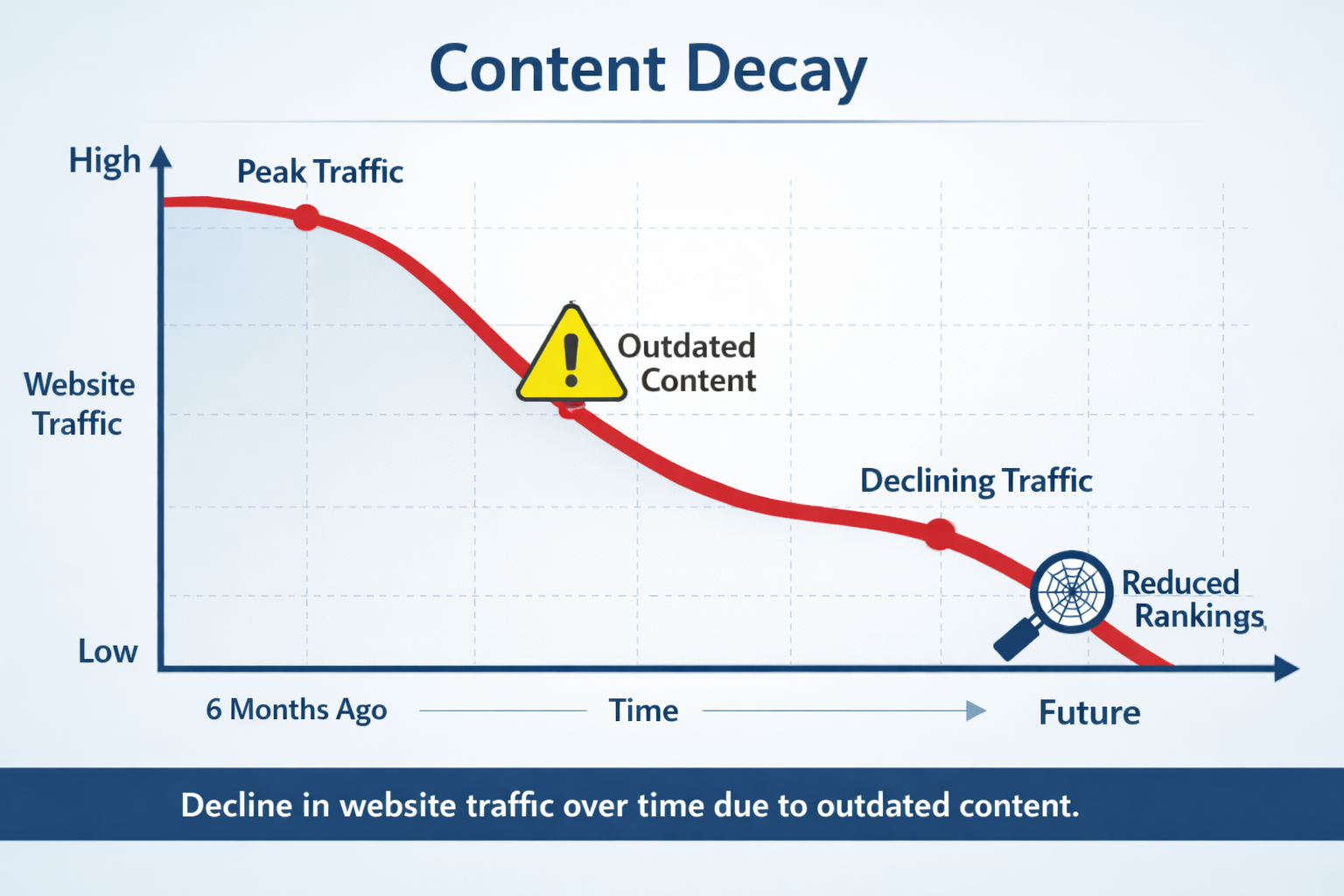
Content decay is a natural process in which you see your rankings and organic traffic start to fall, as time goes on. The outdated information, the growth of competition or the change of the user intent may make even high-quality content unseen. To stay competitive in search results, it’s essential to consistently update and optimize your content.
Having a powerful content update strategy can make you stay ranked, enhance engagement and keep your content up to date so that both users and search engines can find it useful.
What is Content Decay?
Learning about Content Decay in SEO.
Content decay is a decline in rankings and traffic caused by the decreased relevancy of the content with time. Search engines are based on fresh, updated and user oriented information. Without the development of your content, it might lose its place to its competitors who will offer more up-to-date and valuable insights.
Generally the same causes of Content Decay.
The content deterioration may occur because of various causes. Old statistics, inadequate examples, and up-to-date decrease the credibility of your content. Furthermore, the rivals can have more detailed and improved articles and move your rankings down. Alterations in the search intent are also significant as they might make users begin to seek updated or other kinds of information.
Refreshing Content that needs to be refreshed.
Measures to Keep an Eye on.
In order to find out the content decay successfully, you must monitor the performance measurements on a regular basis. The first symptom of the loss of relevance of your content can be a loss in organic traffic. Likewise, the declining ranking and the decrease in the number of clicks signify that people have alternatives which are more effective. You can also check such engagement metrics as bounce rate and time on page to get an idea of whether your content is still of value to users or not.
Audit Process of Content.
A content audit will enable you to review your whole site, and also determine pages not performing to their potential. The first thing you should do is to list all your URLs and examine their performance statistics. Concentrate on pages that have been doing well but are currently performing poorly as they have the best chances of improvement. It is important to set priorities as it will enable you to allocate resources appropriately.
Good Content Refresh Strategies.
Useful Content refresher strategies.
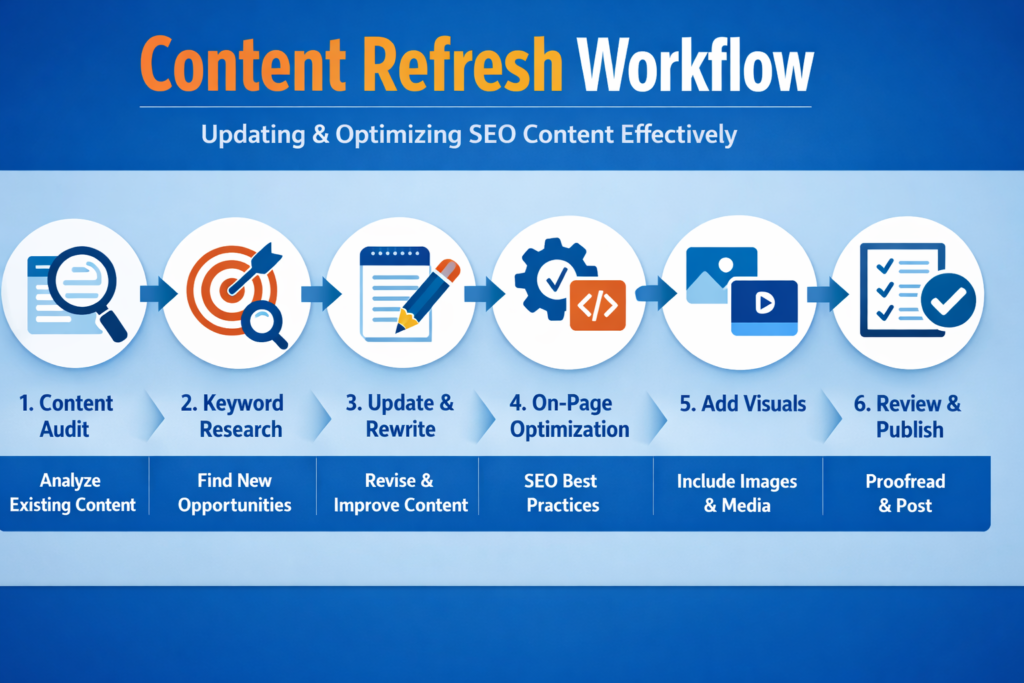
Refreshing a content is not as simple as just updating a couple of lines. It needs to have a strategic tactic of enhancing relevancy and quality. These are some of the good practices:
- Revise irrelevant statistics, facts and sources with recent statistics.
- Include new parts that are missing or trending subtopics.
- Enhance the targeting of keywords according to the existing search intention.
- Make it easier to read, more formatted and structured.
- Include new examples, pictures or case studies.
Improving User Interaction and Interaction.
The user experience is important in the performance of SEO. Properly designed and readable content will keep the users active, and minimize the bounce rates. Split long paragraphs into small ones, have clear headings and include visuals where it is crucial. More user-friendly experience does not only enhance the level of engagement, but it also indicates quality to search engines.
Refresh Improvements in Technical SEO.
Optimization of On-Page SEO.
When refreshing content, it’s important to optimize all on-page SEO elements. This involves changing titles, metadata, headings and alternative texts of images. There should also be an improvement in internal linking in order to link related pages and increase structure of the site. These will assist the search engines to know better about what you have written and increase its visibility.
Mobile Optimization and Performance.
User experience and rankings directly depend on the performance of websites. Make sure that the images load fast and that you minimize the amount of unnecessary scripts. It is also important to optimize the content using mobile devices since a significant percentage of users use mobile devices to access the content. The rapid and quick response website enhances the interest and ranking possibility.
Republishing vs Updating of the contents.
Selecting the appropriate strategy.
The determination of whether to revise or republish content is determined by the amount of changes that are needed. Minor changes can be made within the content but when major changes need to be made then it might be necessary to restructure or republish. In case the subject is still up to date and the page has authority, then updating is typically the most appropriate. The courses of action to take when the content requires a total overhaul would be to republish it.
Constructing Content Refresh Schedule.
Developing a Consistency Update Plan.
It is advisable to have a proactive content refresh schedule as this will make sure that your website continues to remain competitive. Don’t respond to ranking drops, review and update your content regularly. The high performing pages should be audited after a period of a few months and the low performing pages audited more often. Regular updates are also beneficial in preserving constant rankings.
Refresh Checklist High Impact Content.
- Determine pages that have a decreasing traffic and ranking.
- Fix inaccurate data and update information.
- Maximise keywords according to the fashions.
- Enhance the internal connections and organization of the site.
- Improve user experience by making it better formatted.
Measuring the Effect of Content Refresh.
Monitoring the Performance Increases.
Once you have updated your content, then you need to check its performance. Find improvements in ranking of the keywords, organic traffic and the engagement parameters. These metrics will enable you to assess how effective your refresh strategy is and what you can improve to do better.
Conclusion.
The deterioration of content is inevitable, but with a well-thought refresh strategy, it may be easily handled. Over time you can keep and even increase your rankings by updating your content, increasing its quality and ensuring that it is relevant to the current search intent. Such a regular and informative strategy will guarantee its long-term SEO performance and long-term growth of organic traffic.
FAQs.
1. What does content decay mean to SEO?
The deterioration of content in terms of search rankings and traffic caused by the old or less useful content is known as content decay.
2. What frequency is appropriate to update my content?
Preferably, revise valuable material after 3-6 months and update them accordingly.
3. Is content updating beneficial to rankings?
Yes, updated content can be used to enhance the ranking as it will be more relevant and search intent.
4. Is there any need to update content and then change the publish date?
Yes, changing the date of publication can be an indicator of freshness to users and the search engines.
5. What sort of content should be updated on a regular basis?
Trending topics, evergreen content and data-driven articles should be updated on a regular basis to make them relevant.